Friday, October 14, 2011

Nissan fuel cell stack with 250% of the energy density versus 2005 version

Next Big Future
The Nissan Fuel Cell Electric Vehicle (FCEV) is ready to go. They just need the hydrogen distribution network.

Comment:  But that shouldn't be a show stopper.  You can reform hydrocarbons for the hydrogen.  Someone mentioned sulfur poisoning.  If that's the last remaining hurdle, we may see hydrogen powered vehicles soon.
 

Is Mining Rare Minerals on the Moon Vital to National Security?

Space.com

  • "Yes, we know there are local concentrations of REE on the moon," Pieters told SPACE.com, referring to rare earth elements by their acronym REE.
  • KREEP is an acronym based on element symbols for the geochemical component in lunar rocks rich in potassium (K), rare-earth elements (REE), phosphorus (P), thorium, and other incompatible elements, Gertsch explained.
  • KREEP is exposed on the lunar surface in certain areas, Gertsch said. Although rare earth elements are not themselves presently detectable by remote instruments, spotting thorium sharpens the ability to spot associated rare-earth elements on the moon's surface due to similar geochemical properties that caused them to crystallize under the same conditions, she added. 
  • "For rare earths, they are called rare for their low abundance, not economic value. However, some do have practical use in manufacturing, as in superconducting magnets," said Paul Spudis, a planetary scientist and leading advocate for exploring the moon at the Lunar and Planetary Institute in Houston.
  • "The only possible use of such I have heard of is the possibility of mining lunar thorium not a rare earth, strictly speaking, but associated with them to fuel nuclear reactors for power generation at a lunar base. Quite a distant prospect, I suspect," Spudis advised.
  • For Spudis, the real strategic lunar commodity is water.

If all we want from the moon is water, we may as well not go.

Morning Summary, 10/14

Good morning.  A short post to let you know that I'm still out here.

First thing, I did a little housekeeping. The blog is getting a lot of posts, so there's a continual need to improve navigation of this thing.  Well over 2000 posts.

I created a new category so as to break up the Space Colonization category into a sub category called "Moon Madness".  Why use that as a label?  I try to have a sense of humor here.  People probably think colonizing the moon is insane, hence the self deprecating humor.  Perhaps it really is crazy for me to spend my time on something that I will never do.  But it is interesting to me, even if nobody else seems to be interested in it.

Here's some discussion of mild interest to me about the E-cat.   No need to belabor the obvious.  There needs to be more tests, but will Rossi do it?  His mistake may be in trying to cast his skeptics as evil.  He gives that impression because he uses the term "snakes" in order to describe his skeptics.  Sometimes people are just incompetent, not evil.  To his skeptics, Rossi may be the one who is evil.  Some of what they are accusing him of doing would mean that he would be evil indeed, if they were right.  But, I don't see Rossi as evil, nor his opponents.  We need to be more dispassionate about these things.  Science should be about reason, not emotion.

Can people be more reasonable?  Or is that asking too much?  Maybe comparable to expect that cats should bark, and dogs should go "meow".

Thursday, October 13, 2011

Solar thruster calcs

Given that 25 kw of electrical power can be created and, assuming that this will lift 25 times 100 kg/kw equals 2500 kg giving a thrust to mass ratio of 1 to 1:

Let's break down the various components to see what we can come up with:

Allow 500 gallon tank, stainless steel for hydrogen storage, plus insulation 1000 lbs or 454 kg,  400 kg hydrogen fuel equals 854 kg for fuel and tank, 35 kg for a suncube 1 square meter times 64 suncubes to generate 25 kwh of electrical power in space.  We don't need as much mass, because it is in space, no weather issues.  So let's assume that you can cut the cubes weight down by 75%.  That gives 560 kg. for the cubes.  Together, the fuel and the power takes up 1414 kg.
 
Need a heat exchanger and a nozzle, pumps and plumbing.  I am wondering if the heat exchanger and the nozzle can be combined.  That would save mass, hopefully.  Some of the plumbing will be inside the heat exchangers.   This may not be comparable in weight, but this engine here would probably be powerful enough to lift off the moon.   It's mass is 242 kg.  If that is all it weighs, we don't need to worry about exotic new combination of heat exchange and nozzle.  Double the mass for those two.  That gives another 242 kg.

Summing up the two above paragraphs, we arrive at  1898 kg.

That leaves 602 kg.  for all of the rest of your equipment before you even get to crew and crew hab.

But not to worry.  The moon's gravitation is but 1/6 of Earth's, so the thrust to mass ratio can be less than 1 and still lift off.  Perhaps it can be as low as 1/4 to 1.  The Shuttle's thrust to mass at liftoff was 1.5 to 1, so  if you take 1/6th of that, you get about 1/4.  So, we have a lot of room left.  Even if I underestimated by a factor of 2, it would still leave a ratio of 1/2, which is twice 1/4.

This exercise is speculative of course.  I'm not qualified to do a thorough enough and accurate enough job for this, but given the possibility of not being too far off, it would appear that a lunar module could be constructed that would allow you to launch missions off the moon into lunar orbit and beyond.  That could be back to Earth, or to a Lagrangian point where a more capable machine could take you to ???  Mars, maybe?

Lunar launch system

This is the brainstorm that I was thinking about.  The idea was to use Fresnel lenses in order to heat up a reaction mass for thrust.  The reaction mass would be hydrogen obtained from lunar water, presumed to be found in permanently shadowed craters near the polar regions.

After considering this for a little while, cold reality began to make its presence known.  The question arose: what is the maximum temperature that can be reached by such a device?  I'm not sure.  It seems apparent from the video link above that temperatures of over 1000 Farenheit are possible.  But is this enough and is this the limit?

That's a question I can't get an answer to very quickly.  So, I am dropping that idea in favor of another proposition, which would include heating the reaction mass.  There doesn't appear to be much doubt that you could get sufficient power to a device that could heat up some hydrogen to levels of a nuclear thermal rocket.  If you could do that, you could get an Isp of around 800 or 900, which is nearly twice that of the recently retired Space Shuttles' main engines.  Not bad for a compact device, and it would take no nukes to do it.

I recalled Parkins' device, which I covered previously here.  

In the comments section, there's a mention of the NERVA nuclear thermal rocket, which was scheduled to be tested on Apollo 20, which was canceled.  It was space ready.

Back to Parkins: It appears that his device used what is called gyrotrons in order to produce the microwave energy which heats up a heat exchanger.  Hydrogen is passed through it and expelled through a nozzle for thrust.

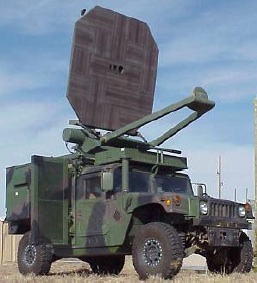
What if a gyrotron could be made small enough so that it could heat up hydrogen in this manner so that it could be used for thrust in a spacecraft?  I looked up gyrotrons on the wikipedia.  On portable application for these devices is in the Active Denial System for the military.
http://en.wikipedia.org/wiki/File:Active_Denial_System_Humvee.jpg
Could such a device could be modified to make it useful for rocket propulsion?  I think the answer could be yes.  Another question is its mass and how much energy does it take and how much does it make?

Mass is important because it imposes great penalties on a rocket.  Another question is the loss in that penalty worth it in terms of performance?  If a rocket could get a 900 Isp with a thing like this, you may be willing to pay for that performance especially since you won't have the mass penalty of having to carry oxygen on board.

Parkins device kept the gyrotrons on the ground, but that imposes its own limits.  If you had a portable one onboard, you could generate your own thrust from solar power and by using hydrogen as a reaction mass. The advantage of hydrogen is that it can enable rocket engines of high Isp to be constructed.   With the gyrotrons, you eliminate the nuclear power component, which has the advantage in that that you won't need radiation shielding.

Could a device such a this have enough thrust to get off the moon?  I'm still thinking about the subject.  Back to that later.

Update:

I'm not sure about the Apollo 20 reference.  But the Nerva nuclear thermal rocket was deemed space worthy.  It could have flown.   It was canceled because it was feared that it would be a commitment to an expensive foray to Mars.  Therefore, it was not due to a failure, but to its success.  The government was afraid of it, in other words.

Morning Summary, 10/13/11

Good morning.

There's not too much more to say about Krivit. After that post, I can't take the dude seriously anymore.

But there's no guarantee that the E-cat will be successful in the long run. Mazda stopped making its rotary engines. A successful concept, but doesn't fit the current market demand. How the E-cat does in the market largely depends upon finding a market for it. I think we are getting to the point where the doubts about its viability are going to be resolved one way or another. Even if it's conceptually viable, it needs to find its market. Or like the rotary engine, it may not make it.


Changing the subject a bit, I've got another brainstorm that I thinking about. It is related to space and it is starting to consume a lot of my thinking. One problem about spaceflight is getting to space economically. Once you get to LEO, you've still got a problem to solve. How to get out of the Earth's gravitation is still a problem. You need a way to do that too. Basically, that is what I am thinking about right now. If I have anything else to post on it, I'll put it up here.

So I'll be keeping my noses in books and such. Posting may be light for awhile. I'll keep up with the usual stuff. Markets and politics and so forth. Just letting you know I'm still out here. So, stay tuned.

Wednesday, October 12, 2011

Titanium deposits on the moon discovered that are ten times the best concentration on Earth

Next Big Future

Comment:  I looked up what John S. Lewis had to say about the moon in his book Mining the Sky.  You can make your own oxygen and iron from materials close at hand.  With any water available in lunar polar regions, you will then have water, oxygen, and a building material.  It is possible to see how one can begin to put together permanent structures and live there.

Krivit's claims of failure of the E-cat

I haven't bothered to read Krivit until this very morning.  I have to say that I am shocked.

He claims failure, but I really don't buy what he says.  I'm sure Krivit has far more credentials than I do. What he says may be believed by those who would weigh what one says against the other.  But I think that he is wrong- on the basis of what he says himself.

It appears to me that he is ignoring the energy that is going out continuously during the heat up phase.  Does he not understand the basic set up?  The set up, as I understand it, was to measure the heat exchanged from the E-cat via a heat exchanger away from the E-cat.  It doesn't matter how the water got heated, the heat exchanger at that point would measure any heat source regardless of how it got there.

Krivit assumes a heat buildup which runs the E-cat in self sustain mode. Hah! This is either a deliberate distortion or he simply doesn't get the set up.  Energy is always flowing out.  Always.

So, during the buildup phase, energy is flowing out of the E-cat into the secondary heat exchanger.  The evidence of this is provided by the data.

Therefore, you can measure energy production which was occurring during the buildup.   It appeared to me that the E-cat was already producing more energy than it was consuming.  Again, this is based upon the continuous flow of energy that was being measured throughout the test.

The electrical energy measured going into the heater was being measured by a device. You can calculate the energy there as input.  The steam output was measured at the E-cat, and once again at the secondary heat exchanger.  You can watch the heat buildup phase and, then as it got to 100 degree Centigrade, the boiling point of water, the secondary temperatures begin to rise.  This indicates a heat exchange taking place at that location.  This is how the output energy was calculated.  The delta t's ( change in temperature) allowed you to calculate the output energy based upon the assumption that you were dealing with water.  Given the fact that it began to record heat exchange at the boiling point of water, it would seem to confirm that it was indeed, water.

People seem to be throwing crap against the wall and hope that something sticks.

Get real.

Monday, October 10, 2011

Rash judgment?

A little about what I've been doing today.

After writing about Moonrush, I listened to the Space Show when the guest was Dr. Robert (Bob) Richards, who has an entry in the Lunar X prize competition.

After that, I went back and looked at the E-cat news on Peswiki. I downloaded a copy of the spreadsheet data file and was going to make a graph of the results, but it was too difficult to work with. I gave up on that.

There was a pretty negative quote on Peswiki which claimed that the thermocouples were in the wrong place and so forth.

It begins to appear that there are questions which weren't apparent to me before. If the data is in any way questionable, there's a problem.  Those who were there say that the machine was producing energy, though. Then I looked at the list of people who were there.  I didn't recognize many of the names.

I'm stepping back a bit from this as it appears that I may have made a rash judgment.

Update:

One more thing:  the energy output after the E-cat was put on self sustain- that was too impressive to be ignored or discounted.  There should be another test.  But Rossi had better silence all the doubters, or they'll win.  Belief alone can't win- you need incontrovertible evidence.

Moon 2.0: Join the Revolution - HD High Definition

Good morning.

I am perusing the Lunar X Prize site to see who's out there and what they intend to do on the moon. This is in connection to the Moonrush post, which may be a useful proposition to colonize the moon without costing the taxpayers a dime.


Update:

LCROSS mission may have struck silver on the moon - space - 21 October 2010 - New Scientist

I had forgotten about this.  You could make coins out of the silver deposits where you also find water.  Cool!

Update:

You could make 1/10 oz. silver coins and have a face value of 1000 dollars.  That would mean that you could mine 100 metric tons for 35 billion.  The coins' face value would be about 300 times its constituent metal's value.  This would be a premium of about 10 to 1.  Too expensive?  That would be a lot of coins too- 352000 per ton.  You could mine less of the stuff and mine other things later.  Silver could be the lowest hanging fruit, though.