Wednesday, June 8, 2011
The Evening Wrap, 6/8
It was a day to check out the actors in this drama with respect to "cold fusion". Martin Fleischmann, Eugene Mallove, and John R. Huizenga. Each are quite accomplished, yet look at what happened. With all this brilliance, one would think something really good would come of it, yet here we are, over a decade into the 21st century, and still no fusion device ( unless the E-cat comes through, and it isn't even called fusion).
By the way, it looks like there was a rush to judgment in 1989. This subsequently poisoned the well, as "cold fusion" fell under a cloud of ill repute. The time line 1) March, when the discovery was made 2) and just a couple months later, the first negative reports came in 3) and finally in November, the negative DOE report. The attacks were unduly harsh. At least one of the harshest critics ( aside from Huizenga ) who was in on the initial negative reactions, also took part in the DOE report. One may get the impression that the intention was to kill off the idea. That's what Mallove believed, plus the motivation to save funding for their own projects.
I think I've looked at this at a number of angles. Although it appears that some injustice was done, and that "cold fusion" is plausible, this is still not proof. The world still waits for this, and the need is greater than ever. Let's hope that Rossi has the goods.
Thanks for coming by, and have a great evening.
Farnsworth Fusor
The team then turned to the AEC, then in charge of fusion research funding, and provided them with a demonstration device mounted on a serving cart that produced more fusion than any existing "classical" device. The observers were startled, but the timing was bad; Hirsch himself had recently revealed the great progress being made by the Soviets using the tokamak. In response to this surprising development, the AEC decided to concentrate funding on large tokamak projects, and reduce backing for alternative concepts
This is a precursor to the Polywell. There is no controversy about the ability here to bring about fusion in a table top device. This device is actually being commercially made today as a source of neutrons. The neutrons that the device produces is evidence of fusion taking place.
This should be evidence enough that you don't need an office sized building in order to produce fusion. To the contrary, hobbyists can reproduce the effect for
In the fusor, the ions are accelerated to several keV by the electrodes, so heating as such is not necessary (as long as the ions fuse before losing their energy by any process). Whereas 45 megakelvins is a very high temperature by any standard, the corresponding voltage is only 4 kV, a level commonly found in such devices as neon lights and televisions.A tremendous of energy is not necessary, provided that you can come up with a suitable confinement strategy that will make fusion possible. In my opinion, there is a possibility that this could occur in a random setting and this could be why "cold fusion" can't be easily reproduced.
Pathological Science?
After awhile, the label becomes the reality. Without funding, and under seige, cold fusioneers became insulated, and perhaps a bit paranoid. On the other hand, the mainstream scientists stayed clear of cold fusion for fear of being punished for studying it.
It should not come to any surprise that a follow up study by the DOE would only confirm what they already believed, that cold fusion was not really real. " In 1994, David Goodstein described cold fusion as:"
There is possibly something pathological going on here, but who is the afflicted party? Going to the government -who itself cannot keep its own house in order- for answers seems an exercise in futility. It is hard to get at the truth when there are so many who seemed determined not to find it.
It should not come to any surprise that a follow up study by the DOE would only confirm what they already believed, that cold fusion was not really real. " In 1994, David Goodstein described cold fusion as:"
Under that cloud, the second DOE review took place and produced unsurprising results.
"a pariah field, cast out by the scientific establishment. Between cold fusion and respectable science there is virtually no communication at all. Cold fusion papers are almost never published in refereed scientific journals, with the result that those works don't receive the normal critical scrutiny that science requires. On the other hand, because the Cold-Fusioners see themselves as a community under siege, there is little internal criticism. Experiments and theories tend to be accepted at face value, for fear of providing even more fuel for external critics, if anyone outside the group was bothering to listen. In these circumstances, crackpots flourish, making matters worse for those who believe that there is serious science going on here."
While significant progress has been made in the sophistication of calorimeters since the review of this subject in 1989, the conclusions reached by the reviewers today are similar to those found in the 1989 review.
The current reviewers identified a number of basic science research areas that could be helpful in resolving some of the controversies in the field, two of which were: 1) material science aspects of deuterated metals using modern characterization techniques, and 2) the study of particles reportedly emitted from deuterated foils using state-of-the-art apparatus and methods. The reviewers believed that this field would benefit from the peer-review processes associated with proposal submission to agencies and paper submission to archival journals.
– Report of the Review of Low Energy Nuclear Reactions, US Department of Energy, December 2004
There is possibly something pathological going on here, but who is the afflicted party? Going to the government -who itself cannot keep its own house in order- for answers seems an exercise in futility. It is hard to get at the truth when there are so many who seemed determined not to find it.
Conflict of interest
A conflict of interest (COI) occurs when an individual or organization is involved in multiple interests, one of which could possibly corrupt the motivation for an act in the other.A conflict of interest can only exist if a person or testimony is entrusted with some impartiality; a modicum of trust is necessary to create it. The presence of a conflict of interest is independent from the execution of impropriety. Therefore, a conflict of interest can be discovered and voluntarily defused before any corruption occurs- Wikipedia
Corruption? Strong word. If corruption is present in government, that would be a problem, would it not?
Cold Fusion: The Scientific Fiasco of the Century (John R. Huizenga)
Just ordered the book
. I'd like to see the other side of the story. I'd like to know why it is supposed to be a fiasco.
Update:
Checking out some info about Huizenga. Quite impressive.
Come to think of it, Mallove's book may have something on him. I'll check that and report here if I find anything.
Update:
This isn't about Huizenga, but while looking at Mallove
's book, I found something that correlates with my own theory about "cold fusion" - check this quote:
Update:
Mallove seems to come down against Huizenga. This is not to cast him as the bad guy, but he is definitely not open to the idea of "cold fusion".
Update:
One last thing about Huizenga. He may have had a conflict of interest since the University of Rochester was involved in a hot fusion program. In other words, he may have had something to gain by shooting down "cold fusion".
Update:
Checking out some info about Huizenga. Quite impressive.
Come to think of it, Mallove's book may have something on him. I'll check that and report here if I find anything.
Update:
This isn't about Huizenga, but while looking at Mallove
three chemists at Brookhaven National Laboratory announced a new way to pull off hot fusion: by using a particle accelerator to fire at a target tiny electrically charged crystals of heavy water- with up to 1,300 heavy water molecules (D20) in each. The laboratory immediately sought patents for this "cluster impact fusion"I wrote earlier that, in comparison with Polywell and Focus Fusion, if you were to hit a small area of matter with sufficient enough energy, you could cause fusion to occur. Here it is, somebody came up with a theory and some evidence to support it years ago.
Update:
Mallove seems to come down against Huizenga. This is not to cast him as the bad guy, but he is definitely not open to the idea of "cold fusion".
Update:
One last thing about Huizenga. He may have had a conflict of interest since the University of Rochester was involved in a hot fusion program. In other words, he may have had something to gain by shooting down "cold fusion".
Martin Fleischmann
Checking out the Wikipedia entry on him shows the following:
- family moved from Czechoslovakia in 1938. This was the same year Hitler and Chamberlain agreed in Munich to carve up the country in exchange for "peace in our time". World War broke out the year later. Hitler slaughtered 6 million Jews.
- 'In 1979, he was awarded the medal for electrochemistry and thermodynamics by the Royal Society of London.'
- 'In 1985 he received the Palladium Medal from the US Electrochemical Society, and in 1986 was elected to the Fellowship of the Royal Society'.
- 'Around 1983, while they were researchers at the University of Utah, he and Stanley Pons found what they believed a way to create nuclear fusion at room temperatures. Fleischmann wanted to publish it first on an obscure journal, and had already spoken with a team that was doing similar work in a different university for a joint publication' [ emphasis added]
- 'On March 26 Fleischmann warned on the Wall Street Journal Report not to try replications until a published paper was available two weeks later in Journal of electroanalytical chemistry'[emphasis added]
- Hundreds tried to replicate anyway and failed. Then the accusations began.
Morning Summary 6/8
Record setting day, thanks for your support! Sitemeter and blogger both topped the old records, which seem to be falling on a regular basis. The big story here is the Rossi Focardi E-cat "cold fusion" story, which is still flying under the radar. Eventually this will get news coverage. It doesn't seem to be possible that this will be held down forever.
I will add that news networks don't have problems reporting hoaxes. Not saying E-cat is a hoax. Just saying that the media may not be smart enough to know the difference! Take the Liberty county mass grave hoax, for example. Boy, did they get faked out. Partly because of this kind of thing, my opinion of the media isn't very high anyway.
The news of the century, a new energy source, is being missed. In the meantime, the media chases down hoaxes with great anticipation and enthusiasm. These people look like dupes.
Anthony Wiener of Wienergate is another example. It looks like the media is carrying water for a politician. Does the media have any basic competence and integrity? Just exactly what is it that they think that they are doing? Is their job to just stand in front of the camera and say something, anything to get attention? How about informing people of what they need to know?
I will add that news networks don't have problems reporting hoaxes. Not saying E-cat is a hoax. Just saying that the media may not be smart enough to know the difference! Take the Liberty county mass grave hoax, for example. Boy, did they get faked out. Partly because of this kind of thing, my opinion of the media isn't very high anyway.
The news of the century, a new energy source, is being missed. In the meantime, the media chases down hoaxes with great anticipation and enthusiasm. These people look like dupes.
Anthony Wiener of Wienergate is another example. It looks like the media is carrying water for a politician. Does the media have any basic competence and integrity? Just exactly what is it that they think that they are doing? Is their job to just stand in front of the camera and say something, anything to get attention? How about informing people of what they need to know?
Tuesday, June 7, 2011
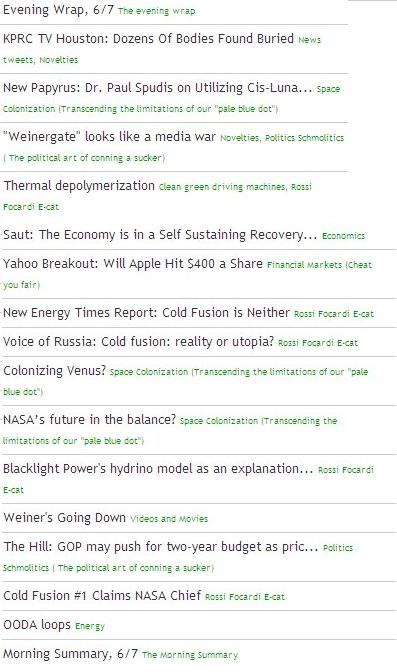
Evening Wrap, 6/7
17 posts today. If that isn't a record, it is close.
At the moment, I'm listening to the Space Show. I've gotten behind on that, but that is a reflection of how much is on my plate. I'm writing this while listening to the program. Talking about multi tasking.
As I'm listening to the show now, they are talking about the Shuttle and being there at the launch.
It has been a great day. But all good things come to an end. Time to shut down for the day. Thanks for coming by, and have a great evening.
New Papyrus: Dr. Paul Spudis on Utilizing Cis-Lunar Space
This is a follow up post on an earlier post today. ( h/t New Papyrus)
Nothing like having a video to look at and listen to and to think over. There was a pdf link in the previous post.
I wrote about the Moon Base concept that he proposed several months ago. He mentions his concept again in this speech.
Nothing like having a video to look at and listen to and to think over. There was a pdf link in the previous post.
I wrote about the Moon Base concept that he proposed several months ago. He mentions his concept again in this speech.
Thermal depolymerization
Thermal depolymerization (TDP) is a depolymerization process using hydrous pyrolysis for the reduction of complex organic materials (usually waste products of various sorts, often biomass and plastic) into light crude oil. It mimics the natural geological processes thought to be involved in the production of fossil fuels.
I remember reading about this for the first time several years ago on the Parapundit blog. It was about processing turkey waste into a high quality biofuel. That post yesterday, of Andrea Fossi doing something similar in Europe reminded me of this post.
It occurred to me several weeks ago that you could use fossil fuels as a source of hydrogen for fuel cells. This was already demonstrated by the Chrysler NeCar close to 10 years ago. This car had an onboard methanol reformer, which produced the hydrogen for the fuel cell. Inasmuch as internal combustion engines are so inefficient as compared to the fuel cell, it would seem that the use of this biofuel as a hydrogen source would be a better choice.
Now, you wouldn't necessarily want to put the reformer on the car. Instead, put the reformer at the refueling station and let the motorist refill with hydrogen there. No need for a big infrastructure investment. The only hurdle remaining would be to get the hydrogen fuel cell prices down to a level that would be economically competitive.
I kept reading further and came across algal fuel. I read up on that too several years ago. At the time, the cost per gallon for algal fuel was over 20 dollars per gallon. It seems that the price has come down. In any event, the use of the reformers could work here as well. You may even be able to collect the co2 and resuse it for the next batch of biofuel.
For the discussion about fuel cells, check out the post labeled 'Clean green driving machines'. Incidentally, one of the reasons for space advocacy is to mine asteroids (or the Moon!) for platinum for use in the fuel cells.
Subscribe to:
Posts (Atom)