It's a plan alright, but all plans are subject to that little something called uncertainty. None of this is certain. HOWEVER, if there is a will to do this in spite of the difficulties, then one thing IS certain. They will succeed.
The missing ingredient is this: Is there a will to do it?
It seems highly doubtful to me. Since this plan came from the Trump administration, a will a Democrat administration follow it? Don't bet on it. It hasn't been happening in recent history. Every change of party leads to a change in NASA priorities.
Showing posts with label Major Topic --- Space: Why not a Moon Base?. Show all posts
Showing posts with label Major Topic --- Space: Why not a Moon Base?. Show all posts
Thursday, September 10, 2026

Thursday, August 20, 2026
BFR's potential
8/20/26:
There was an article on NextBigFuture, mentioned courtesy of Free Republic, which was about the BFR's development cost. It is estimated to be anywhere from $2 billion to $10 billion.
Given the great potential of this rocket, it would be of the utmost national importance for the government to grant enough business to SpaceX so that they can have the necessary funds to develop the rocket.
You could do this with a moonbase project. It was estimated by NASA to be a project that was doable under the current NASA funding scheme. The actual numbers ran out to about half of the Apollo project.
If a moonbase was turned into a commitment, such as with Apollo, it could be done in ten years at a price that should be even less than the NASA number. Of course, SpaceX would have to win a competitive bidding war. But it should be done as a national priority.
The government is not likely to do this however, as funding tends to get spread out over a number of states. This doesn't work well with one company getting the lion's share of the business.
What purpose would a moonbase serve? It could process lunar regolith into fuel. The fuel could be used for deep space missions.
The most likely fuel from the moon would be oxygen. Oxygen is not a fuel, but is a reaction mass. For all intents and purposes, it is the same thing.
For the raptor engine, which uses methane, oxygen would be close to 80% of the reaction mass. In such a scenario, it would be profitable for the BFR to land on the moonbase, load the oxygen, and transport it to a refueling depot at the L1 Lagrange point.
The advantage of using these points is that it takes less energy to get to the Lagrange point than to the moon itself. Morever, the big rocket could be mostly fueled up for a trip outbound to Mars and other destinations. One big rocket can service the Lagrange point, and provide extra for more ambitious missions.
Almost all of a rocket's launch mass is fuel and oxygen, so if you can get it elsewhere as opposed to the Earth, you can vastly improve access to the Moon and points beyond.
Interesting to review this in light of what actually happened. SpaceX didn't call it the BFR, but renamed it the Starship/Heavy. The cost of development of the rocket itself came in at about the number mentioned below (if memory serves of one estimate I saw).
A moonbase will likely be constructed, as a return to the moon is now a NASA priority. Elon Musk wants to develop the Moon too.
I would favor a new ship be constructed that would launch from the moon to an EML collection point. It would be huge and capable of transporting thousands of colonists in relative comfort and safety. It would likely be a torus that could be rotated, and would have ample shielding from the deadly cosmic rays in interplanetary space.
The lunar base could supply some of the materials for the ship. The rest could come from the Earth. The "Battleship Galactica" would launch from an EML spot, which would require a minimum of Delta V to get into a Martian Capture orbit. From there, the crew could disembark via the Starship on multiple visits to the Martian surface. It could refuel there as many times as needed in order to bring all the colonists to the surface of Mars.
One hundred thousand colonists could traverse the distance from the EML location to Mars on each Holman cycle of about two years. Thus it would take about 20 years to get a million colonists on Mars.
There was an article on NextBigFuture, mentioned courtesy of Free Republic, which was about the BFR's development cost. It is estimated to be anywhere from $2 billion to $10 billion.
Given the great potential of this rocket, it would be of the utmost national importance for the government to grant enough business to SpaceX so that they can have the necessary funds to develop the rocket.
You could do this with a moonbase project. It was estimated by NASA to be a project that was doable under the current NASA funding scheme. The actual numbers ran out to about half of the Apollo project.
If a moonbase was turned into a commitment, such as with Apollo, it could be done in ten years at a price that should be even less than the NASA number. Of course, SpaceX would have to win a competitive bidding war. But it should be done as a national priority.
The government is not likely to do this however, as funding tends to get spread out over a number of states. This doesn't work well with one company getting the lion's share of the business.
What purpose would a moonbase serve? It could process lunar regolith into fuel. The fuel could be used for deep space missions.
The most likely fuel from the moon would be oxygen. Oxygen is not a fuel, but is a reaction mass. For all intents and purposes, it is the same thing.
For the raptor engine, which uses methane, oxygen would be close to 80% of the reaction mass. In such a scenario, it would be profitable for the BFR to land on the moonbase, load the oxygen, and transport it to a refueling depot at the L1 Lagrange point.
The advantage of using these points is that it takes less energy to get to the Lagrange point than to the moon itself. Morever, the big rocket could be mostly fueled up for a trip outbound to Mars and other destinations. One big rocket can service the Lagrange point, and provide extra for more ambitious missions.
Almost all of a rocket's launch mass is fuel and oxygen, so if you can get it elsewhere as opposed to the Earth, you can vastly improve access to the Moon and points beyond.
Wednesday, August 5, 2026
Why go back to the Moon?
8/5/26:
The nation is now committed to going to the Moon again.
Not only the nation, but Elon Musk.
There are practical reasons for going there. There is an abundance of oxygen bound up in the rocks. Oxygen makes up roughly 80% of the reaction mass for the Raptor engines. This reaction mass can be sent to lunar orbit with relatively little cost through the use of propulsion devices on the surface. That could consist of the same kind of technology that flings jets off the new Ford class of Supercarriers--no fuel needed. Not only oxygen, but methane could be produced from the water recycling process used on the ISS. Methane is vented off the ISS, but methane could find some useful purposes on the lunar surface as well. One of these purposes could be in the manufacture of rocket fuels.
The Moon could also be a launching point for the trip to Mars, since its
gravitational pull is much less than Earth's. Since the Ship would be full, it could develop a lot more delta-v for a faster trip. A faster trip could lower the exposure of the crew to microgravity and radiation.
The moon could also be developed for its other resources. This and the reasons above could make it economically profitable in its own right. In other words, there's money to be made.
An analysis of the speech is here.
Key points of the analysis:
- Fear of Sputnik, and the breakneck speed of advancement of that time prepared the audience in advance for the ambitious undertaking that the President advocated. America must lead that effort, he said.
- The march of progress will go on whether we lead it or not.
- Framed within the context of the Cold War, and inextricably linked to it, it was hard for opponents to be critical of the President's goal.
- Need to be challenged--- "We go to the moon not because it is easy, because it is hard."
- There will be sacrifice of life and treasure, but the sacrifice will be worth it.
- It is like the reason given for climbing Mt. Everest, "it is there".
- Finally, the speech was said to be well executed and effective.
How does that speech compare with the present? There is no Cold War, but there could be a conflict of some kind on the horizon with China. The march of progress has gone on indeed, and is much more broad based than just space. The US is in danger of being left behind across the board, in my opinion. As for the need for a challenge, it is probably more necessary now than ever. This country has become too inured to the easy way out. We need the challenge so that we don't become too soft.
Mt. Everest is still there, and so is the Moon. Why not go? We may be surprised at what we find.
Tuesday, February 17, 2026
What about it-- How SpaceX will build their moonbase
Moon base Alpha, eh? Did SpaceX rip off this name, or is it an original name?
Friday, February 6, 2026
Space Station idea discussed
2/6/26:
Another video no longer operative, so this one is substituted in its stead. A note about this original post: I recall that John Hunter said that a gas gun could put something from the moon into lunar orbit, and the gas could be at room temperature. So, if memory serves, that is definitely something to think about right there.
2/16/13:
Using a Hunter Gas gun to deploy a space station from the moon.
Sunday, January 29, 2012
What went wrong?
It may be too early to do this post, as the primary has not been held yet. Conventional wisdom has it that Romney will win in Florida. Doing a post mortem on a campaign that isn't dead yet has some risks, not only for the "patient", but the "coroner".
It may not be too early to mention what has gone wrong so far.
Gingrich gave an excellent and reasonable speech on space policy last week. But it is being caricatured as a bit of "zaniness" that is supposed to be typical of Newt. The cover of National Review had Newt caricatured as "Marvin the Martian", which did nothing to endear me towards that publication. To top it all off, Romney has added injury to insult with a dishonest debate answer about excessive costs. For this, he is considered to have won- by somebody or something. Yet, if true, it was a hollow victory by an undeserving victor over a worthy opponent.
For one may rightly ask, if a presidential candidate can't make a serious speech about a serious subject, during a time of angst about the future, when can he? If there was a time for a speech like this, this was it. If there was a place for a speech like this, it was Florida. It decidedly wasn't the wrong time, nor the wrong place, nor flawed subject matter. It all fit perfectly, as far as I can tell, into what everyone needed to hear. But it wasn't totally and irrefutably perfect in all ways to all people.
Thus it is said to have been rejected, if the polls are any indication.
As for the specific proposals, they are not perfect perhaps. But what is? Isn't the process supposed to iron out deficiencies? Should perfection be the enemy of the good? Evidently the polls and the gods say so. It may be hard, politically to put a base on the moon, we are told, and for that reason the speech isn't perfect. If the speech isn't perfect, why, it must be worthless. If the speech is worthless, the speaker is a horrible candidate. World without end.
One can believe that the "fix is in", but that doesn't mean everybody has to fall into line. That doesn't mean everybody has to give up their own judgment. But if you believe the polls, it is imperative that you fall into line. You must. If you don't, the evil Obama will win. Why? Why the gods say so. You must not question the gods.
Technically it is said to be feasible. Economically it is said to be feasible, but hard. But politically it is too hard. Whatever happened to "yes we can"? It has morphed into "you'd better not". If you ask, "why not?", you are told that it can't be done. If you challenge the assumptions behind the denial, you are ignored. You are crazy. You are deluded. But why? Because somebody or something says so?
It is true that space is hard, but it is not true that space is impossible. It is true that politics of space may be hard, but it has also been shown not to be impossible. Economics does not have to be a problem- flexibility isn't impossible either. It is only impossible if you believe it to be so. A shift in priorities and the use of best practices can bring in the project under budget and on time. It only takes the will to do it, and maybe that is the explanation for everything.
If there's no will, there can be no way.
If Gingrich made a mistake, maybe it is because he thought too highly of us. Or do we think too highly of polls? If we let polls do our thinking for us, Gingrich may have been mistaken after all.
It may not be too early to mention what has gone wrong so far.
Gingrich gave an excellent and reasonable speech on space policy last week. But it is being caricatured as a bit of "zaniness" that is supposed to be typical of Newt. The cover of National Review had Newt caricatured as "Marvin the Martian", which did nothing to endear me towards that publication. To top it all off, Romney has added injury to insult with a dishonest debate answer about excessive costs. For this, he is considered to have won- by somebody or something. Yet, if true, it was a hollow victory by an undeserving victor over a worthy opponent.
For one may rightly ask, if a presidential candidate can't make a serious speech about a serious subject, during a time of angst about the future, when can he? If there was a time for a speech like this, this was it. If there was a place for a speech like this, it was Florida. It decidedly wasn't the wrong time, nor the wrong place, nor flawed subject matter. It all fit perfectly, as far as I can tell, into what everyone needed to hear. But it wasn't totally and irrefutably perfect in all ways to all people.
Thus it is said to have been rejected, if the polls are any indication.
As for the specific proposals, they are not perfect perhaps. But what is? Isn't the process supposed to iron out deficiencies? Should perfection be the enemy of the good? Evidently the polls and the gods say so. It may be hard, politically to put a base on the moon, we are told, and for that reason the speech isn't perfect. If the speech isn't perfect, why, it must be worthless. If the speech is worthless, the speaker is a horrible candidate. World without end.
One can believe that the "fix is in", but that doesn't mean everybody has to fall into line. That doesn't mean everybody has to give up their own judgment. But if you believe the polls, it is imperative that you fall into line. You must. If you don't, the evil Obama will win. Why? Why the gods say so. You must not question the gods.
Technically it is said to be feasible. Economically it is said to be feasible, but hard. But politically it is too hard. Whatever happened to "yes we can"? It has morphed into "you'd better not". If you ask, "why not?", you are told that it can't be done. If you challenge the assumptions behind the denial, you are ignored. You are crazy. You are deluded. But why? Because somebody or something says so?
It is true that space is hard, but it is not true that space is impossible. It is true that politics of space may be hard, but it has also been shown not to be impossible. Economics does not have to be a problem- flexibility isn't impossible either. It is only impossible if you believe it to be so. A shift in priorities and the use of best practices can bring in the project under budget and on time. It only takes the will to do it, and maybe that is the explanation for everything.
If there's no will, there can be no way.
If Gingrich made a mistake, maybe it is because he thought too highly of us. Or do we think too highly of polls? If we let polls do our thinking for us, Gingrich may have been mistaken after all.
What are the near and long term advantages of a Permanent Moon Base?
nextbigfuture.com
quote:
Comment:
Judging from the comments to the post, there's a lot of doubt out there as to the value of the proposition. However, this is often true with respect to anything new and innovative. Clearly, there is a need for something to inspire us all, but the naysayers and doomsters will never be the ones to do that. If people throughout history had been listening to them all along, we would all still be living in trees and caves.
quote:
It is a new beachhead for the initiation of space industrialization.
Comment:
Judging from the comments to the post, there's a lot of doubt out there as to the value of the proposition. However, this is often true with respect to anything new and innovative. Clearly, there is a need for something to inspire us all, but the naysayers and doomsters will never be the ones to do that. If people throughout history had been listening to them all along, we would all still be living in trees and caves.
Saturday, January 7, 2012
Articles: Red Flag on the Red Planet
American Thinker: China's Great Leap Marsward?
In order to get my point of view on the topic of a moonbase, click on the category label below.
Meanwhile, President Obama has scuttled his predecessor's project to establish a manned scientific outpost on the Moon; as America's space program withers, China's thrives.Comment:
In order to get my point of view on the topic of a moonbase, click on the category label below.
Thursday, December 22, 2011
Moon Mines: Visionary or Senseless?
National Space Society Blog h/t Instapundit
quotes:
I'd say this is just the beginning of what it could do.
quotes:
- a vigorous lunar mining system could be part of a system to deliver energy to Earth, build large structures in space, and even provide radiation protection, water and oxygen to those who want to spend significant time in orbit.
- the evidence suggests that reorienting our space program to support commercialization and industrialization of space, as opposed to 100% government missions, may produce far greater results at much less cost.
- Lunar mining could be a major component of such space industrialization.
I'd say this is just the beginning of what it could do.
Thursday, December 15, 2011
Why Newt's Lunar Base Is a Good Idea
Ray Villard, Discovery News via RealClearScience
quote:
Comment:
Gingrich's name is misspelled, but that's ok! I like moon base idea, of course. I've been writing about it for months.
quote:
This is where Gingerich’s moon mining moon base comes in. Humans would be needed to go to the moon to operate a large drilling rig to burrow thorough lava layers and take core samples with the telltale isotopic record from the sun's travels.
Perhaps only through the potential big bucks of commercial lunar mining could geologic science have an opportunity to hitchhike back to the moon's surface. The geological exploration would hit an unintended pay dirt far more valuable than helium 3 -- a history book of our sun's galactic odyssey.
Comment:
Gingrich's name is misspelled, but that's ok! I like moon base idea, of course. I've been writing about it for months.
Tuesday, December 13, 2011
Monday, December 12, 2011
Proposal: Removing Earth's Radiation Belts
This is a similar idea I read in the book reported on this time last year.
One of many useful tasks could be the removal of the Van Allen Belts. Other tasks include removing space junk, repairing and removing non functional satellites, and guarding space from rogue asteroids. This is in addition to supporting exploration and development.
It is much cheaper to launch from the moon ( 14 times cheaper according to this). Wouldn't it make sense to do this or at least look into doing it? Gingrich appears to be interested. Romney's criticism is based upon the current paradigm. That paradigm has to be replaced with a new paradigm of cheaper access to space. The current space program is not about that, to put it bluntly.
One of many useful tasks could be the removal of the Van Allen Belts. Other tasks include removing space junk, repairing and removing non functional satellites, and guarding space from rogue asteroids. This is in addition to supporting exploration and development.
It is much cheaper to launch from the moon ( 14 times cheaper according to this). Wouldn't it make sense to do this or at least look into doing it? Gingrich appears to be interested. Romney's criticism is based upon the current paradigm. That paradigm has to be replaced with a new paradigm of cheaper access to space. The current space program is not about that, to put it bluntly.
Wednesday, November 30, 2011
Space Based Solar Power Status
nextbigfuture.com
excerpts:
It may be useful to start small and ramp it up if you can make it work. Let's say you want to power something the size of the ISS, which uses about a quarter Megawatt of power. That something could be a VASIMR. Put four or more of these in geosynchoronous orbit and beam the power down to an orbiting VASIMR in order to allow it to get to various places in LEO or to a higher orbit.
Ultimately, you could have solar power device manufacturing on the moon and launch it from the moon. The moon requires much less energy to get out the gravity well. In addition to that, there's no atmosphere to contend with.
excerpts:
- the progress status of SSPS in Japan
- the advantages of Japan's SSPS technology
- Other Space Based Solar Work
- Solaren and other small companies that have made big Space Solar promises
- Space Island Group, Orbital Power Corp
- National Space Society tracks Space Solar Power Developments
It may be useful to start small and ramp it up if you can make it work. Let's say you want to power something the size of the ISS, which uses about a quarter Megawatt of power. That something could be a VASIMR. Put four or more of these in geosynchoronous orbit and beam the power down to an orbiting VASIMR in order to allow it to get to various places in LEO or to a higher orbit.
Ultimately, you could have solar power device manufacturing on the moon and launch it from the moon. The moon requires much less energy to get out the gravity well. In addition to that, there's no atmosphere to contend with.
Tuesday, November 22, 2011
Plan to establish first lunar base and gas stations in space
gizmag h/t Transterrestrial Musings
Comment: Amazing talk. Here's somebody who wants to do it privately and he is raising money. He wants to do it in seven years. Wow.
His plan is a lot cheaper than Paul Spudis' plan. Who wins that race?
Comment: Amazing talk. Here's somebody who wants to do it privately and he is raising money. He wants to do it in seven years. Wow.
His plan is a lot cheaper than Paul Spudis' plan. Who wins that race?
Thursday, November 17, 2011
Kenneth Murphy on Nov. 8th Space Show
This show got my attention, so I downloaded it on a mp3 format file and listened in.
The reason that I'm interested, is of course, that I"m so focused upon going to the moon first.
Unfortunately, for those such as myself who would prefer to go the Moon first, this current resident of the White House has determined that we don't need to go there again since we have been there before.
That's true, that we have been there before, but only for flags and footprints. If the only point is to go to the Moon, then we are really done with it. But what if the Moon has plenty of good economic reasons to go there? Why not go there for economic reasons, besides just going there to look cool and take pictures? If there was an economic reason to go there, the incentive would in place for cost controls that would make it profitable as an economic enterprise.
The last part of the show, which was over 2 hours long, was that same gloom and doom about America that has turned me off in the past. But the warning is definitely there, for anybody who is bothering to look. One point is that none of the young generation wants to study science and engineering for the purpose of space exploration and development because there's not proper incentive for them to do so. As mentioned above, the one incentive to go there was pulled right out from under them when Obama canceled the Constellation program.
Mind you, this is not just political bashing. Obama didn't just modify the program, he canceled it outright. What would it have taken to make things just a little differently than what was already scheduled? Like keeping the Ares I and canceling the Ares V type rockets. You could then slightly modify the shuttle and make it for cargo only.
The Ares I could be close to operational now if it hadn't been canceled. The lower stage has been tested already. The second stage could have been what has just been tested recently and now will probably be canceled itself. The J2X could have been that second stage with the only remaining thing left as the capsule itself, which is nearly ready now.
Murphy wants to go around NASA altogether. If that happens, those in government have nobody to blame but themselves. Not only that, but the government is failing us, and this is but one example of how they are doing it.
We now how a heavy lift rocket on tap, but will be quite expensive. The trouble now is that same rocket will itself be canceled before it ever gets built. What if it was just a plain old Shuttle C, with minimal modifications and need for research and development? Could that not have been done? But it won't be and now this latest incarnation is vulnerable.
Murphy says that we need to bring value to the space program, or it won't survive. There's no value in developing hardware and then scrapping it and never using it, or under-utilizing it. It happened with the Saturn V, it happened with the Shuttle, and it has happened with Constellation. Even the ISS was going to be canceled before Obama rescued it. It isn't just Obama, it's the entire political class who do not have proper incentive to get value for the taxpayer. The space program is a high profile example of why governments incentives are skewed toward inefficiency and waste. The excuse is that they never have enough money, but if they didn't waste so much money, they'd be able to get more done.
Murphy says we need to develop cis lunar architecture. This would save money, but the incentive, as mentioned, is in another direction. The incentive is in making heavy lift rockets, which are expensive. Super rockets as opposed to the use of a refueling infrastructure, which would be more economical. Value, as Murphy suggests, is not properly incentivized in government, as it is in the private sector.
Another problem is cultural. Too many people out there don't see value in space. Even those amongst the religious sort, there is some "uncomfortable" feelings associated with the idea of settling or exploring space. They actually fear the threat to their belief systems with regard to the settlement of space. This doesn't show much faith, but the very opposite. Why would anyone fear that unless one is really insincere in one's belief? Great confidence and faith are incompatible with fear. Frankly, I don't believe that a truly Christian person would feel any threat whatsoever with space exploration and settlement. In this respect, I think the leadership in this segment of our society is also to blame. Fearful people do not belong in leadership positions.
In sum, what it would take to get back on track would be to improve incentives. To achieve that, the space advocacy community must do a bit of evangelizing upon the opportunities and values of space. That community is small, so it needs to be expanded. The public needs to be educated and motivated, so as to be steered away from irrational fears. Provided that the community can reach enough people, and properly expanded, the politicians will be incentivized into paying and attention and making the proper decisions in the future that will assure a future for mankind in space.
The reason that I'm interested, is of course, that I"m so focused upon going to the moon first.
Unfortunately, for those such as myself who would prefer to go the Moon first, this current resident of the White House has determined that we don't need to go there again since we have been there before.
That's true, that we have been there before, but only for flags and footprints. If the only point is to go to the Moon, then we are really done with it. But what if the Moon has plenty of good economic reasons to go there? Why not go there for economic reasons, besides just going there to look cool and take pictures? If there was an economic reason to go there, the incentive would in place for cost controls that would make it profitable as an economic enterprise.
The last part of the show, which was over 2 hours long, was that same gloom and doom about America that has turned me off in the past. But the warning is definitely there, for anybody who is bothering to look. One point is that none of the young generation wants to study science and engineering for the purpose of space exploration and development because there's not proper incentive for them to do so. As mentioned above, the one incentive to go there was pulled right out from under them when Obama canceled the Constellation program.
Mind you, this is not just political bashing. Obama didn't just modify the program, he canceled it outright. What would it have taken to make things just a little differently than what was already scheduled? Like keeping the Ares I and canceling the Ares V type rockets. You could then slightly modify the shuttle and make it for cargo only.
The Ares I could be close to operational now if it hadn't been canceled. The lower stage has been tested already. The second stage could have been what has just been tested recently and now will probably be canceled itself. The J2X could have been that second stage with the only remaining thing left as the capsule itself, which is nearly ready now.
Murphy wants to go around NASA altogether. If that happens, those in government have nobody to blame but themselves. Not only that, but the government is failing us, and this is but one example of how they are doing it.
We now how a heavy lift rocket on tap, but will be quite expensive. The trouble now is that same rocket will itself be canceled before it ever gets built. What if it was just a plain old Shuttle C, with minimal modifications and need for research and development? Could that not have been done? But it won't be and now this latest incarnation is vulnerable.
Murphy says that we need to bring value to the space program, or it won't survive. There's no value in developing hardware and then scrapping it and never using it, or under-utilizing it. It happened with the Saturn V, it happened with the Shuttle, and it has happened with Constellation. Even the ISS was going to be canceled before Obama rescued it. It isn't just Obama, it's the entire political class who do not have proper incentive to get value for the taxpayer. The space program is a high profile example of why governments incentives are skewed toward inefficiency and waste. The excuse is that they never have enough money, but if they didn't waste so much money, they'd be able to get more done.
Murphy says we need to develop cis lunar architecture. This would save money, but the incentive, as mentioned, is in another direction. The incentive is in making heavy lift rockets, which are expensive. Super rockets as opposed to the use of a refueling infrastructure, which would be more economical. Value, as Murphy suggests, is not properly incentivized in government, as it is in the private sector.
Another problem is cultural. Too many people out there don't see value in space. Even those amongst the religious sort, there is some "uncomfortable" feelings associated with the idea of settling or exploring space. They actually fear the threat to their belief systems with regard to the settlement of space. This doesn't show much faith, but the very opposite. Why would anyone fear that unless one is really insincere in one's belief? Great confidence and faith are incompatible with fear. Frankly, I don't believe that a truly Christian person would feel any threat whatsoever with space exploration and settlement. In this respect, I think the leadership in this segment of our society is also to blame. Fearful people do not belong in leadership positions.
In sum, what it would take to get back on track would be to improve incentives. To achieve that, the space advocacy community must do a bit of evangelizing upon the opportunities and values of space. That community is small, so it needs to be expanded. The public needs to be educated and motivated, so as to be steered away from irrational fears. Provided that the community can reach enough people, and properly expanded, the politicians will be incentivized into paying and attention and making the proper decisions in the future that will assure a future for mankind in space.
Friday, October 21, 2011
Single Stage to Orbit (SSTO) would be useful for the moon too
Actually, this problem was solved during the Apollo years. The tiny ascent stage on the Lunar Module, which weighed only a little over 10,000 pounds, was a SSTO vehicle. The problem is that you need to double up on it, so that it can do both ascent and descent in the same vehicle. Which it did, but at the cost of 32,399 pounds of hardware. The downside is that it could not be reused. Still got a launch problem, as with the Earth.
I've been researching the topic, and found some interesting stuff. A single VASIMR engine can tow 7 metric tons to a low lunar orbit. If you can keep the weight of a theoretically reusable Lunar Module under that, you can get your Lunar Module into place for a sortie on the lunar surface. The ascent stage for the Apollo programs was less than 5 metric tons. So, if you can do this, you can have the lion's share of an architecture that can do this type of job, and it could all be fully reusable. One more thing is that the VASIMR can't take the astronauts. Some other means needs to be found for that.
I'll stop here and post this as an introduction. I'll update it as the day goes along. Keep tuned.
Update:
The original post on this subject, I assumed 10,000 kg. There were some errors in the spreadsheet, so I calibrated it, so to speak, by filling in the spreadsheet using Apollo data:
From there, I re worked the spreadsheet to get back to a 900 ISP monopropellant propulsion (assuming this is possible). Mass savings were achieved for propellant, but came at the cost of extra hardware. Hopefully, the hardware can fit on the spacecraft and not be too heavy.
It may be possible to add additional mass, since the VASIMR can get it to LLO (low lunar orbit) from LEO (low Earth orbit). So, I added the extra mass, which brings it back up to 7000 kg. This is less than the original 10,000 kg, but within the capability of the VASIMR from LEO.
It is heavy, so let's lighten it up a little and assume only oxygen monopropellant. Why oxygen? Because the moon is loaded with it. You can harvest it directly from the lunar surface at just about any location. This gives us the capability to set up "filling stations" all over the lunar surface and get to any part of it.
I found that by using oxygen, it got too heavy, so I deleted some mass. Hopefully, the configuration is feasible.
I think that it isn't assuming too much that an oxygen only propellant can achieve an ISP at the upper range of a conventional hydrogen oxygen combustion engine. Thus, we are adding 1500 kg in wet mass without needing more fuel. We can replace the existing rocket engines and add our new hardware, while hopefully remaining under the weight limit. (cross your fingers)
If this can be achieved, the entire lunar surface is available to us.
Update:
It looks like getting oxygen out of moon rocks may be more of a challenge that I thought. ( What else is new?) Anyway, it would be a great idea to go to the lunar poles first, and get situated there.
It turns out that you can obtain your oxygen from the iron oxides on the moon, but you have to beneficiate them first, then use a redox reaction to get the oxygen out. You get the oxygen out in the form of water or carbon dioxide, depending upon what reducing agent you use- hydrogen or carbon monoxide. You will at least need a source of hydrogen, and also carbon, which may be available at the poles as well.
I was thinking at some point, you'll want to move from the polar regions to get towards all of the lunar surface area. You can use lunar oxygen as the reaction mass, you can hop across the surface using nothing more than that as a transportation fuel. Technically, it would use hydrogen and oxygen in fuel cells, but these elements can be regenerated from the water that the fuel cell produces. The sun would then be powering your machine, as the energy will be stored in the hydrogen, and thus making hydrogen as the energy carrier for solar power.
Once you have spread out from the polar regions, you can mine the surface for platinum group metals (pgms). Those can be exported to Earth and used there for the hydrogen economy.
Oh, by the way. You may wonder: why oxygen? Doesn't that present a problem with oxidizing everything? It turns out that the Space Shuttle's thermal protection used a material that wouldn't oxidize even during the heat of reentry. You can use that for your heat exchanger. Parkin's microwave thruster, upon which this idea is based, does the same.
Update: 10/23/11
It looks as if my idea has a serious flaw. Or at least one serious flaw that I now know about. The energy calculations are off. So this idea appears to be off the table. &^*$!!!!.
I've been researching the topic, and found some interesting stuff. A single VASIMR engine can tow 7 metric tons to a low lunar orbit. If you can keep the weight of a theoretically reusable Lunar Module under that, you can get your Lunar Module into place for a sortie on the lunar surface. The ascent stage for the Apollo programs was less than 5 metric tons. So, if you can do this, you can have the lion's share of an architecture that can do this type of job, and it could all be fully reusable. One more thing is that the VASIMR can't take the astronauts. Some other means needs to be found for that.
I'll stop here and post this as an introduction. I'll update it as the day goes along. Keep tuned.
Update:
The original post on this subject, I assumed 10,000 kg. There were some errors in the spreadsheet, so I calibrated it, so to speak, by filling in the spreadsheet using Apollo data:
 |
| Gives us our baseline spacecraft |
 |
| Does saving 1350 kg in fuel help us? |
 |
| Maxxed out at 7000 kg, but this is too heavy for my taste. Can we lighten it up a little? |
I found that by using oxygen, it got too heavy, so I deleted some mass. Hopefully, the configuration is feasible.
 |
| Mono propellant reaction mass using oxygen, with ISP of 460, the same as for hydrogen combustion |
I think that it isn't assuming too much that an oxygen only propellant can achieve an ISP at the upper range of a conventional hydrogen oxygen combustion engine. Thus, we are adding 1500 kg in wet mass without needing more fuel. We can replace the existing rocket engines and add our new hardware, while hopefully remaining under the weight limit. (cross your fingers)
If this can be achieved, the entire lunar surface is available to us.
Update:
It looks like getting oxygen out of moon rocks may be more of a challenge that I thought. ( What else is new?) Anyway, it would be a great idea to go to the lunar poles first, and get situated there.
It turns out that you can obtain your oxygen from the iron oxides on the moon, but you have to beneficiate them first, then use a redox reaction to get the oxygen out. You get the oxygen out in the form of water or carbon dioxide, depending upon what reducing agent you use- hydrogen or carbon monoxide. You will at least need a source of hydrogen, and also carbon, which may be available at the poles as well.
I was thinking at some point, you'll want to move from the polar regions to get towards all of the lunar surface area. You can use lunar oxygen as the reaction mass, you can hop across the surface using nothing more than that as a transportation fuel. Technically, it would use hydrogen and oxygen in fuel cells, but these elements can be regenerated from the water that the fuel cell produces. The sun would then be powering your machine, as the energy will be stored in the hydrogen, and thus making hydrogen as the energy carrier for solar power.
Once you have spread out from the polar regions, you can mine the surface for platinum group metals (pgms). Those can be exported to Earth and used there for the hydrogen economy.
Oh, by the way. You may wonder: why oxygen? Doesn't that present a problem with oxidizing everything? It turns out that the Space Shuttle's thermal protection used a material that wouldn't oxidize even during the heat of reentry. You can use that for your heat exchanger. Parkin's microwave thruster, upon which this idea is based, does the same.
Update: 10/23/11
It looks as if my idea has a serious flaw. Or at least one serious flaw that I now know about. The energy calculations are off. So this idea appears to be off the table. &^*$!!!!.
Wednesday, October 19, 2011
Who said the moon isn't made of cheese? "Green" cheese, that is.
I making puns out the wazoo here. You don't get it? The kind of cheese I'm talking about is green.
But it is also green because of this
All I'm saying is that you can make money off the moon and promote "greener" policies on Earth. And it doesn't have to cost too much money.
You can mine lunar platinum, for example. That can be used for fuel cells on Earth. You can make solar power satellites and launch them from the moon into Earth orbit. From there it can provide energy to the Earth.
It takes less energy to get from the Moon to Earth orbit, so it will be more economical.
Hydrogen can be obtained from seawater and made into methanol and shipped to wherever it is needed. Methanol can be electrolyzed back into hydrogen, while saving the carbon dioxide, making it carbon neutral.
The solar power satellites and the platinum can sustain a lunar colony, which saves the expense of getting there because someone is already there. Their being there has to be sustained and the reason for being there will be sustained because there are resources on the moon which can be exploited. The economic activity can expand further into deeper space, yielding additional returns.
You can also fashion new worlds from lunar materials. Getting to and from an Earth Moon Lagragian point to another point in space is a lot easier and cheaper than launching rockets from the ground- even if launch costs come way down. Space exploration and settlement becomes all the more economically feasible and profitable. This will yield benefits on the ground, making everyone better off.
 |
| http://www.urbandictionary.com/define.php?term=cheese |
 |
| http://instesre.org/Solar/ApolloEarthRise.jpg |
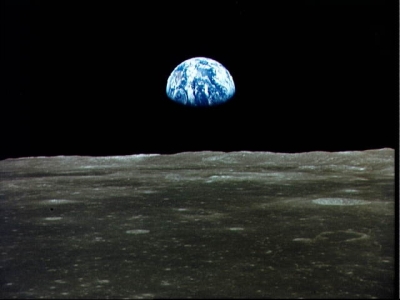
You can mine lunar platinum, for example. That can be used for fuel cells on Earth. You can make solar power satellites and launch them from the moon into Earth orbit. From there it can provide energy to the Earth.
It takes less energy to get from the Moon to Earth orbit, so it will be more economical.
Hydrogen can be obtained from seawater and made into methanol and shipped to wherever it is needed. Methanol can be electrolyzed back into hydrogen, while saving the carbon dioxide, making it carbon neutral.
The solar power satellites and the platinum can sustain a lunar colony, which saves the expense of getting there because someone is already there. Their being there has to be sustained and the reason for being there will be sustained because there are resources on the moon which can be exploited. The economic activity can expand further into deeper space, yielding additional returns.
You can also fashion new worlds from lunar materials. Getting to and from an Earth Moon Lagragian point to another point in space is a lot easier and cheaper than launching rockets from the ground- even if launch costs come way down. Space exploration and settlement becomes all the more economically feasible and profitable. This will yield benefits on the ground, making everyone better off.
Friday, October 14, 2011
Is Mining Rare Minerals on the Moon Vital to National Security?
Space.com
If all we want from the moon is water, we may as well not go.
- "Yes, we know there are local concentrations of REE on the moon," Pieters told SPACE.com, referring to rare earth elements by their acronym REE.
- KREEP is an acronym based on element symbols for the geochemical component in lunar rocks rich in potassium (K), rare-earth elements (REE), phosphorus (P), thorium, and other incompatible elements, Gertsch explained.
- KREEP is exposed on the lunar surface in certain areas, Gertsch said. Although rare earth elements are not themselves presently detectable by remote instruments, spotting thorium sharpens the ability to spot associated rare-earth elements on the moon's surface due to similar geochemical properties that caused them to crystallize under the same conditions, she added.
- "For rare earths, they are called rare for their low abundance, not economic value. However, some do have practical use in manufacturing, as in superconducting magnets," said Paul Spudis, a planetary scientist and leading advocate for exploring the moon at the Lunar and Planetary Institute in Houston.
- "The only possible use of such I have heard of is the possibility of mining lunar thorium not a rare earth, strictly speaking, but associated with them to fuel nuclear reactors for power generation at a lunar base. Quite a distant prospect, I suspect," Spudis advised.
- For Spudis, the real strategic lunar commodity is water.
If all we want from the moon is water, we may as well not go.
Thursday, October 13, 2011
Solar thruster calcs
Given that 25 kw of electrical power can be created and, assuming that this will lift 25 times 100 kg/kw equals 2500 kg giving a thrust to mass ratio of 1 to 1:
Let's break down the various components to see what we can come up with:
Allow 500 gallon tank, stainless steel for hydrogen storage, plus insulation 1000 lbs or 454 kg, 400 kg hydrogen fuel equals 854 kg for fuel and tank, 35 kg for a suncube 1 square meter times 64 suncubes to generate 25 kwh of electrical power in space. We don't need as much mass, because it is in space, no weather issues. So let's assume that you can cut the cubes weight down by 75%. That gives 560 kg. for the cubes. Together, the fuel and the power takes up 1414 kg.
Need a heat exchanger and a nozzle, pumps and plumbing. I am wondering if the heat exchanger and the nozzle can be combined. That would save mass, hopefully. Some of the plumbing will be inside the heat exchangers. This may not be comparable in weight, but this engine here would probably be powerful enough to lift off the moon. It's mass is 242 kg. If that is all it weighs, we don't need to worry about exotic new combination of heat exchange and nozzle. Double the mass for those two. That gives another 242 kg.
Summing up the two above paragraphs, we arrive at 1898 kg.
That leaves 602 kg. for all of the rest of your equipment before you even get to crew and crew hab.
But not to worry. The moon's gravitation is but 1/6 of Earth's, so the thrust to mass ratio can be less than 1 and still lift off. Perhaps it can be as low as 1/4 to 1. The Shuttle's thrust to mass at liftoff was 1.5 to 1, so if you take 1/6th of that, you get about 1/4. So, we have a lot of room left. Even if I underestimated by a factor of 2, it would still leave a ratio of 1/2, which is twice 1/4.
This exercise is speculative of course. I'm not qualified to do a thorough enough and accurate enough job for this, but given the possibility of not being too far off, it would appear that a lunar module could be constructed that would allow you to launch missions off the moon into lunar orbit and beyond. That could be back to Earth, or to a Lagrangian point where a more capable machine could take you to ??? Mars, maybe?
Let's break down the various components to see what we can come up with:
Allow 500 gallon tank, stainless steel for hydrogen storage, plus insulation 1000 lbs or 454 kg, 400 kg hydrogen fuel equals 854 kg for fuel and tank, 35 kg for a suncube 1 square meter times 64 suncubes to generate 25 kwh of electrical power in space. We don't need as much mass, because it is in space, no weather issues. So let's assume that you can cut the cubes weight down by 75%. That gives 560 kg. for the cubes. Together, the fuel and the power takes up 1414 kg.
Need a heat exchanger and a nozzle, pumps and plumbing. I am wondering if the heat exchanger and the nozzle can be combined. That would save mass, hopefully. Some of the plumbing will be inside the heat exchangers. This may not be comparable in weight, but this engine here would probably be powerful enough to lift off the moon. It's mass is 242 kg. If that is all it weighs, we don't need to worry about exotic new combination of heat exchange and nozzle. Double the mass for those two. That gives another 242 kg.
Summing up the two above paragraphs, we arrive at 1898 kg.
That leaves 602 kg. for all of the rest of your equipment before you even get to crew and crew hab.
But not to worry. The moon's gravitation is but 1/6 of Earth's, so the thrust to mass ratio can be less than 1 and still lift off. Perhaps it can be as low as 1/4 to 1. The Shuttle's thrust to mass at liftoff was 1.5 to 1, so if you take 1/6th of that, you get about 1/4. So, we have a lot of room left. Even if I underestimated by a factor of 2, it would still leave a ratio of 1/2, which is twice 1/4.
This exercise is speculative of course. I'm not qualified to do a thorough enough and accurate enough job for this, but given the possibility of not being too far off, it would appear that a lunar module could be constructed that would allow you to launch missions off the moon into lunar orbit and beyond. That could be back to Earth, or to a Lagrangian point where a more capable machine could take you to ??? Mars, maybe?
Lunar launch system
This is the brainstorm that I was thinking about. The idea was to use Fresnel lenses in order to heat up a reaction mass for thrust. The reaction mass would be hydrogen obtained from lunar water, presumed to be found in permanently shadowed craters near the polar regions.
After considering this for a little while, cold reality began to make its presence known. The question arose: what is the maximum temperature that can be reached by such a device? I'm not sure. It seems apparent from the video link above that temperatures of over 1000 Farenheit are possible. But is this enough and is this the limit?
That's a question I can't get an answer to very quickly. So, I am dropping that idea in favor of another proposition, which would include heating the reaction mass. There doesn't appear to be much doubt that you could get sufficient power to a device that could heat up some hydrogen to levels of a nuclear thermal rocket. If you could do that, you could get an Isp of around 800 or 900, which is nearly twice that of the recently retired Space Shuttles' main engines. Not bad for a compact device, and it would take no nukes to do it.
I recalled Parkins' device, which I covered previously here.
In the comments section, there's a mention of the NERVA nuclear thermal rocket, which was scheduled to be tested on Apollo 20, which was canceled. It was space ready.
Back to Parkins: It appears that his device used what is called gyrotrons in order to produce the microwave energy which heats up a heat exchanger. Hydrogen is passed through it and expelled through a nozzle for thrust.
What if a gyrotron could be made small enough so that it could heat up hydrogen in this manner so that it could be used for thrust in a spacecraft? I looked up gyrotrons on the wikipedia. On portable application for these devices is in the Active Denial System for the military.
Could such a device could be modified to make it useful for rocket propulsion? I think the answer could be yes. Another question is its mass and how much energy does it take and how much does it make?
Mass is important because it imposes great penalties on a rocket. Another question is the loss in that penalty worth it in terms of performance? If a rocket could get a 900 Isp with a thing like this, you may be willing to pay for that performance especially since you won't have the mass penalty of having to carry oxygen on board.
Parkins device kept the gyrotrons on the ground, but that imposes its own limits. If you had a portable one onboard, you could generate your own thrust from solar power and by using hydrogen as a reaction mass. The advantage of hydrogen is that it can enable rocket engines of high Isp to be constructed. With the gyrotrons, you eliminate the nuclear power component, which has the advantage in that that you won't need radiation shielding.
Could a device such a this have enough thrust to get off the moon? I'm still thinking about the subject. Back to that later.
Update:
I'm not sure about the Apollo 20 reference. But the Nerva nuclear thermal rocket was deemed space worthy. It could have flown. It was canceled because it was feared that it would be a commitment to an expensive foray to Mars. Therefore, it was not due to a failure, but to its success. The government was afraid of it, in other words.
After considering this for a little while, cold reality began to make its presence known. The question arose: what is the maximum temperature that can be reached by such a device? I'm not sure. It seems apparent from the video link above that temperatures of over 1000 Farenheit are possible. But is this enough and is this the limit?
That's a question I can't get an answer to very quickly. So, I am dropping that idea in favor of another proposition, which would include heating the reaction mass. There doesn't appear to be much doubt that you could get sufficient power to a device that could heat up some hydrogen to levels of a nuclear thermal rocket. If you could do that, you could get an Isp of around 800 or 900, which is nearly twice that of the recently retired Space Shuttles' main engines. Not bad for a compact device, and it would take no nukes to do it.
I recalled Parkins' device, which I covered previously here.
In the comments section, there's a mention of the NERVA nuclear thermal rocket, which was scheduled to be tested on Apollo 20, which was canceled. It was space ready.
Back to Parkins: It appears that his device used what is called gyrotrons in order to produce the microwave energy which heats up a heat exchanger. Hydrogen is passed through it and expelled through a nozzle for thrust.
What if a gyrotron could be made small enough so that it could heat up hydrogen in this manner so that it could be used for thrust in a spacecraft? I looked up gyrotrons on the wikipedia. On portable application for these devices is in the Active Denial System for the military.
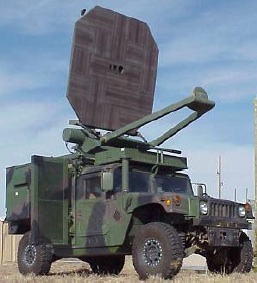 |
| http://en.wikipedia.org/wiki/File:Active_Denial_System_Humvee.jpg |

Mass is important because it imposes great penalties on a rocket. Another question is the loss in that penalty worth it in terms of performance? If a rocket could get a 900 Isp with a thing like this, you may be willing to pay for that performance especially since you won't have the mass penalty of having to carry oxygen on board.
Parkins device kept the gyrotrons on the ground, but that imposes its own limits. If you had a portable one onboard, you could generate your own thrust from solar power and by using hydrogen as a reaction mass. The advantage of hydrogen is that it can enable rocket engines of high Isp to be constructed. With the gyrotrons, you eliminate the nuclear power component, which has the advantage in that that you won't need radiation shielding.
Could a device such a this have enough thrust to get off the moon? I'm still thinking about the subject. Back to that later.
Update:
I'm not sure about the Apollo 20 reference. But the Nerva nuclear thermal rocket was deemed space worthy. It could have flown. It was canceled because it was feared that it would be a commitment to an expensive foray to Mars. Therefore, it was not due to a failure, but to its success. The government was afraid of it, in other words.
Subscribe to:
Posts (Atom)